
Loading
Loading
About NDF
What NDF set out to do, in its own words, and how it worked in the villages.
Conservation, development and educating the people to make equitable use of national resources.
Organisation of agrarian life, attainment of the country's self sufficiency through rural development and conducting dedicated work to cultivate a spirit of self reliance among the peasants.
Instillation of an awareness of their rights in the minds of Sri Lankan citizens, leading the people in the spirit of unity and fraternity toward the fulfilment of varied functions that become necessary in the process of conservation and development of national resources.
Creation of a definite pattern of education with the religious centres at its head, for the purpose of promoting spiritual and material development.
Establishment of a sense of discipline and a state of self-governing among the people through the improvement of their religious, cultural, social and economic standards.
Getting the people acquainted with the rational utilisation of the public funds allocated by the State for their benefit.
Adopting necessary measures to protect the national environment.
Accomplishment of the tasks that help to move toward an improvement of the masses.
Organisation and execution of all activities that deem necessary for the protection of the consumer.
Adoption of all measures conducive to the preservation of natural, creative, economic and moral wealth and extension of support for such measures by voluntary and state bodies.
Maintaining relations with national and international organisations in the intent of securing the aforementioned aims.
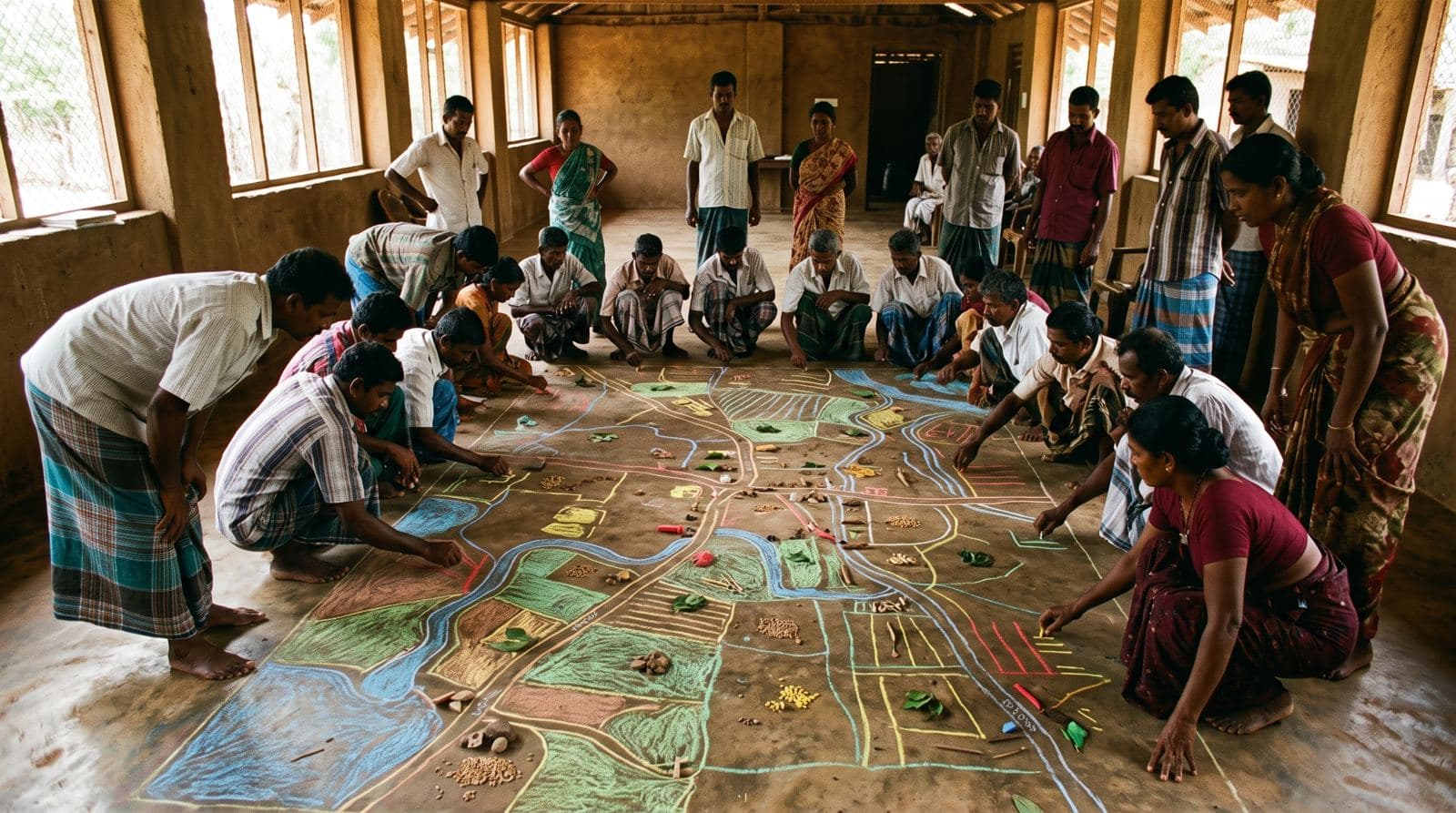
NDF staff and local youths survey the village: land, families, income, who farms where.
Villagers form their own society. In one tank this took nine months. NDF waited.
A survey of the tank with Department of Agrarian Services staff, who gave their time free. NDF paid food and transport.
The society reviews the plan and agrees to the work and its own contribution.
The NDF head office sends the proposal to funders, mainly the Australian Freedom From Hunger Campaign.
Farmers do the earthwork. Each member pays half to one bushel of unmilled rice a season into a tank fund for future repairs.
How tanks were chosen
An empowered, just and free society where people live in equanimity and enjoy socio-economic, political, religio-cultural and social rights equally.
The booklet lists the methods NDF practised and trained others in. The activities list credits NDF with introducing Participatory Rural Appraisal to Sri Lanka, working with Robert Chambers, and participatory monitoring and evaluation, working with Alexandra Stephens. NDF-ACT-001
M.H.S. Dayaratne, IIMI, about 1991
The NDF approach made farmers owners of the systems and moved them toward self-management, in contrast to assistance programmes that kept communities in a dependency trap.
Vimaladharma, 1990
Compared NDF with the statutory Freedom From Hunger Campaign Board. NDF has no model. The community decides the type of project.
Perera, 1988
An outside consultant's assessment of the Kurunegala tank work, cited in the IIMI evaluation. We do not hold the text.